
RupeeCase | Systematic Quantitative Investing Terminal by QC AlphaRupeeCase | Systematic Quantitative Investing Terminal by QC AlphaRupeeCase | Systematic Quantitative Investing Terminal by QC AlphaRupeeCase | Systematic Quantitative Investing Terminal by QC Alpha
Start free
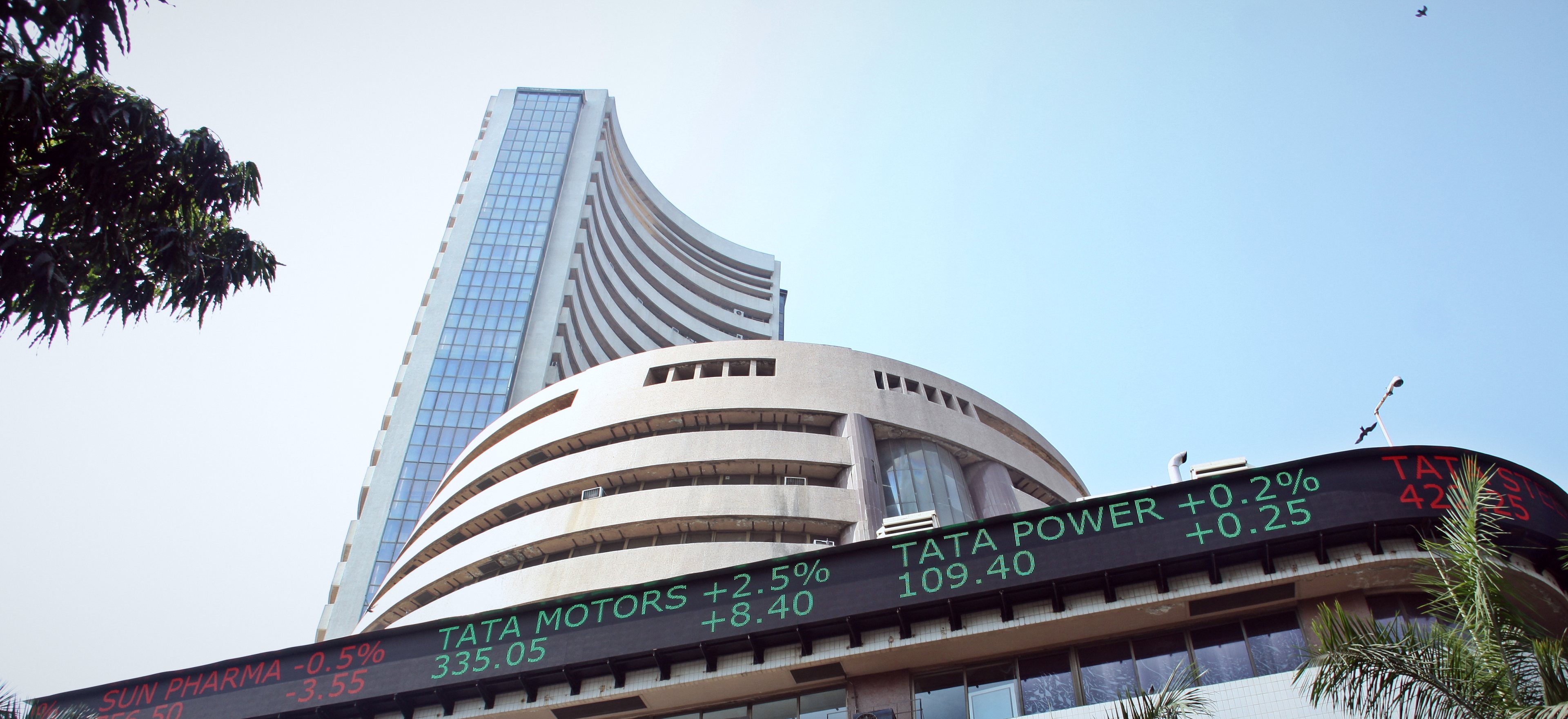
The Mumbai skyline at night

18 institutional grade index algos, live

India’s first systematic investing terminal.

Pick one of 18 rules based indices on NSE and BSE. Your own broker places the orders and the shares stay in your demat. One fee per rebalance, like brokerage. Nothing else.

Sign up for RupeeCase

An index you can actually own.

Hands holding a phone against city lights at night, a RupeeCase strategy on screen

01Marketplace and research

Every strategy,
in your hand.

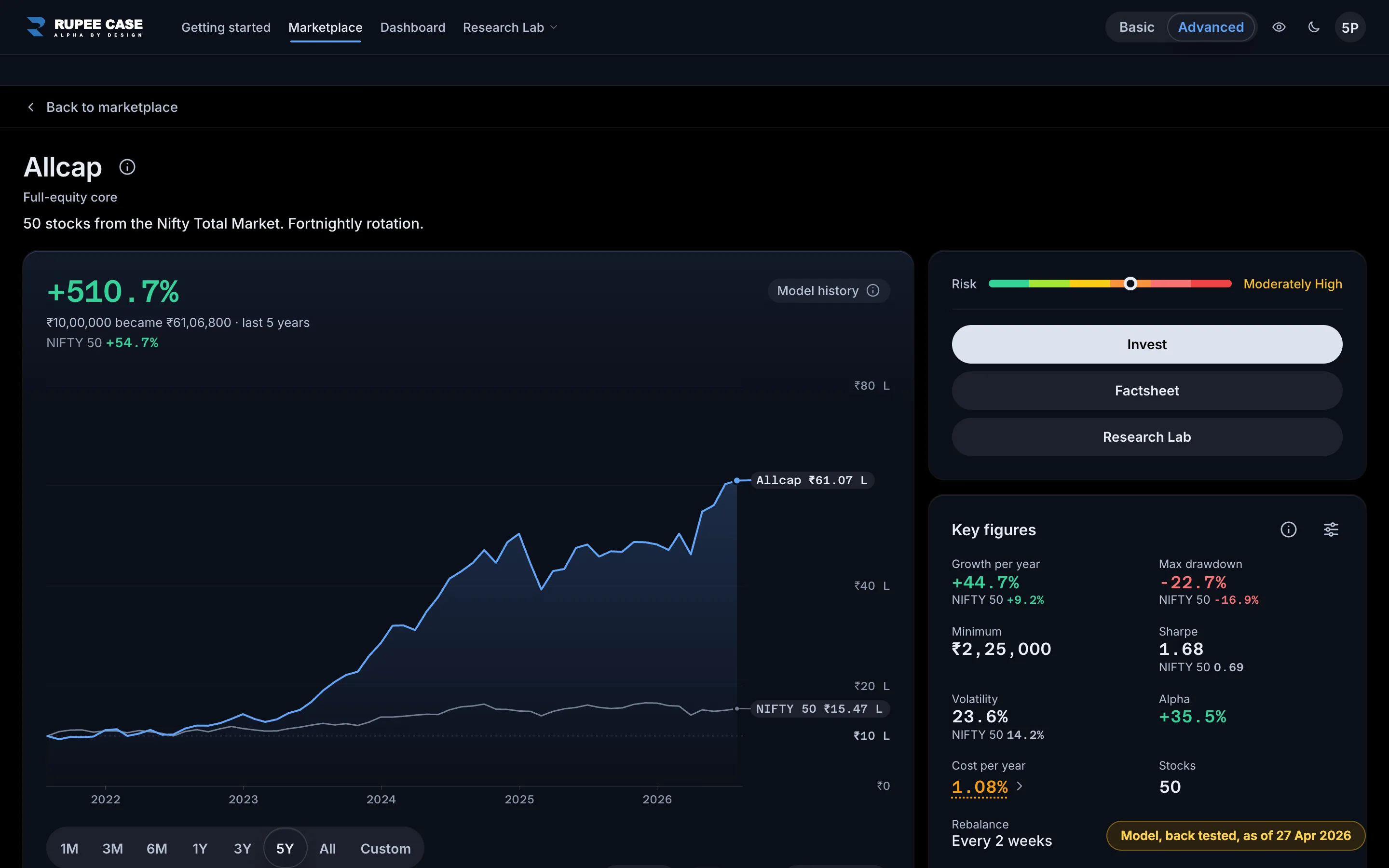
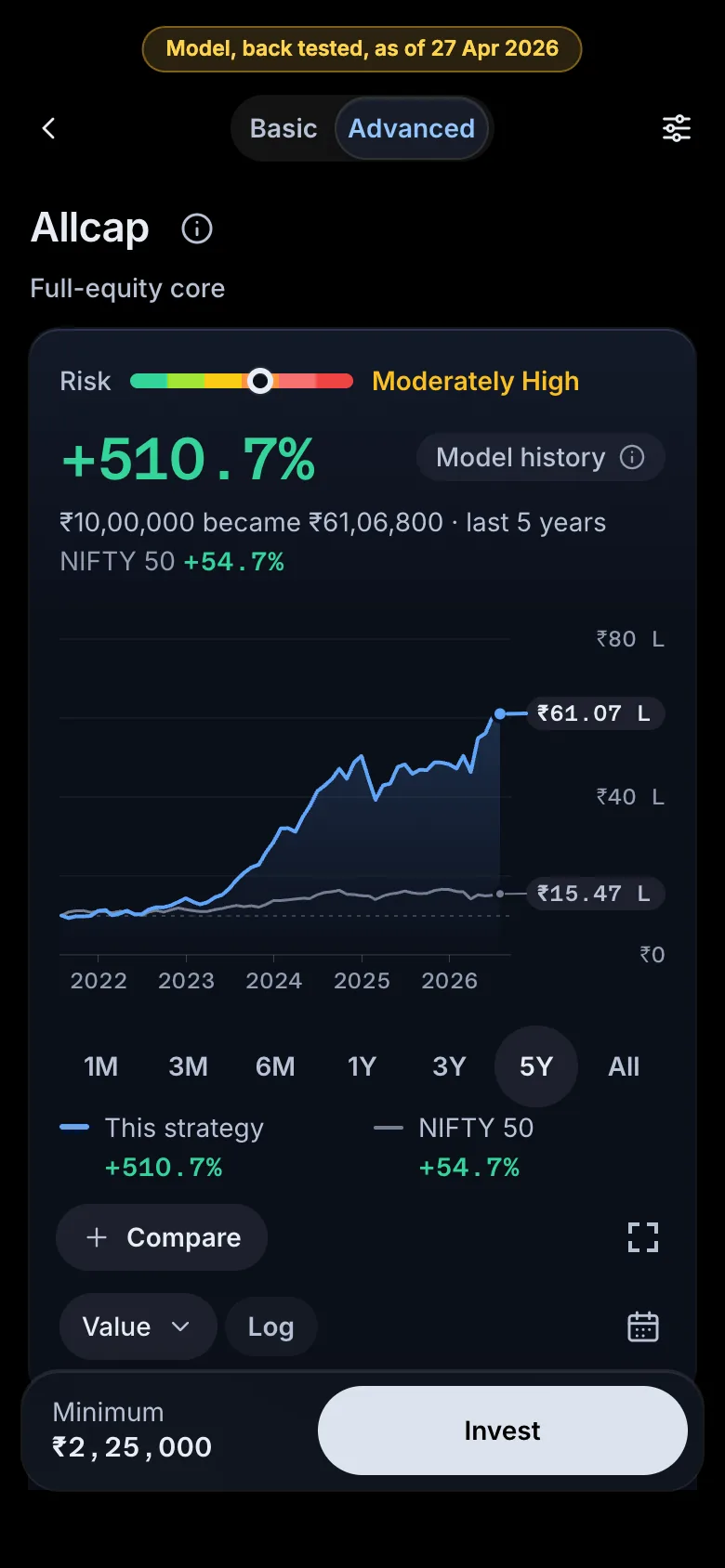
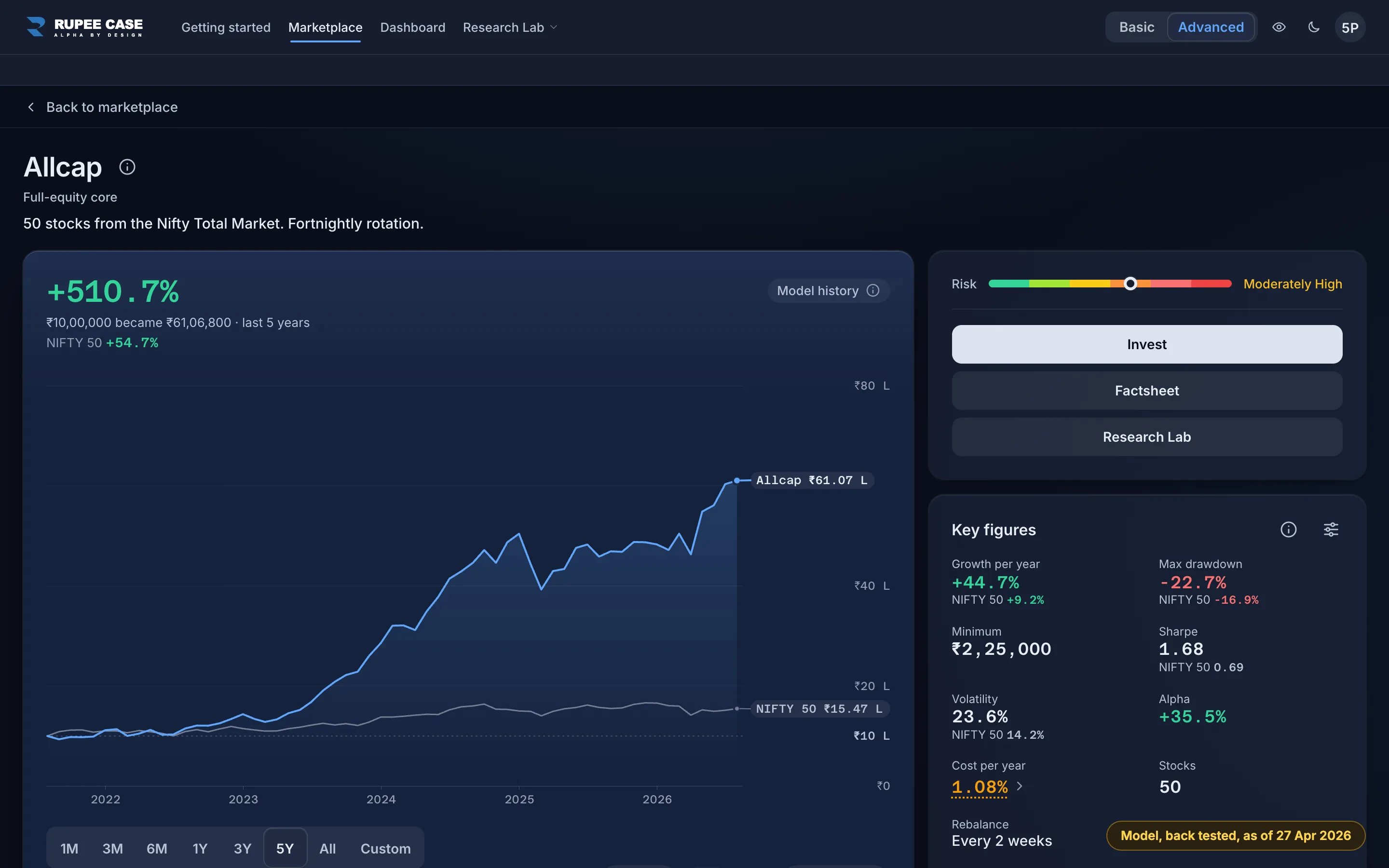
Read the record before you invest: model history against the Nifty 50, every drawdown, the holdings and the rebalance calendar, on one page.

  • After chargesmodel returns, labelled as model
  • Risk meteron every strategy card
  • Basic or Advancedthe essentials, or every figure
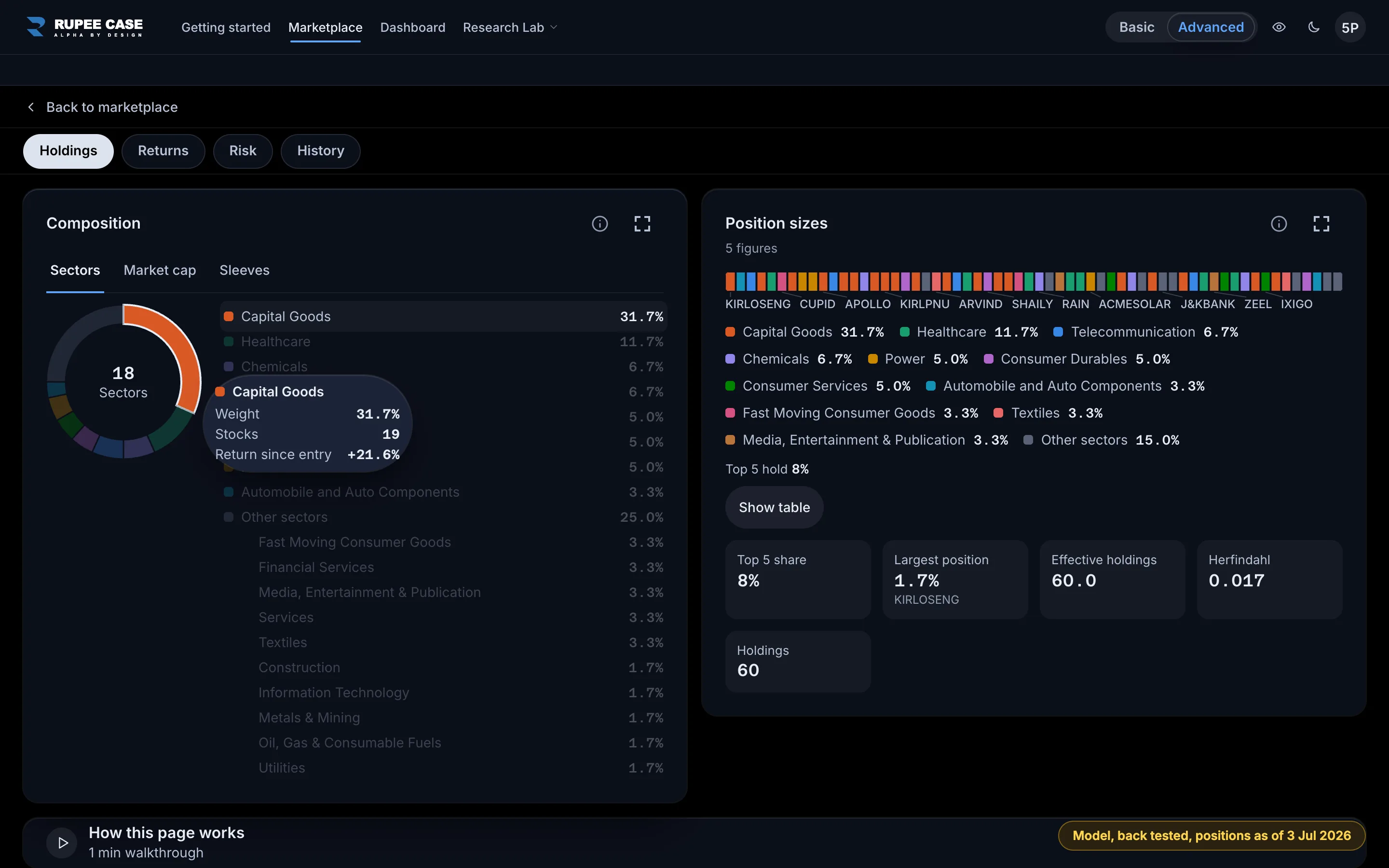
  • Holdingsevery stock and weight
  • Factsheetone page, ready to share

Open one:AllcapMidcapDynamic Asset AllocatorAll 18 in one table

02The terminal

A terminal, not a fund.

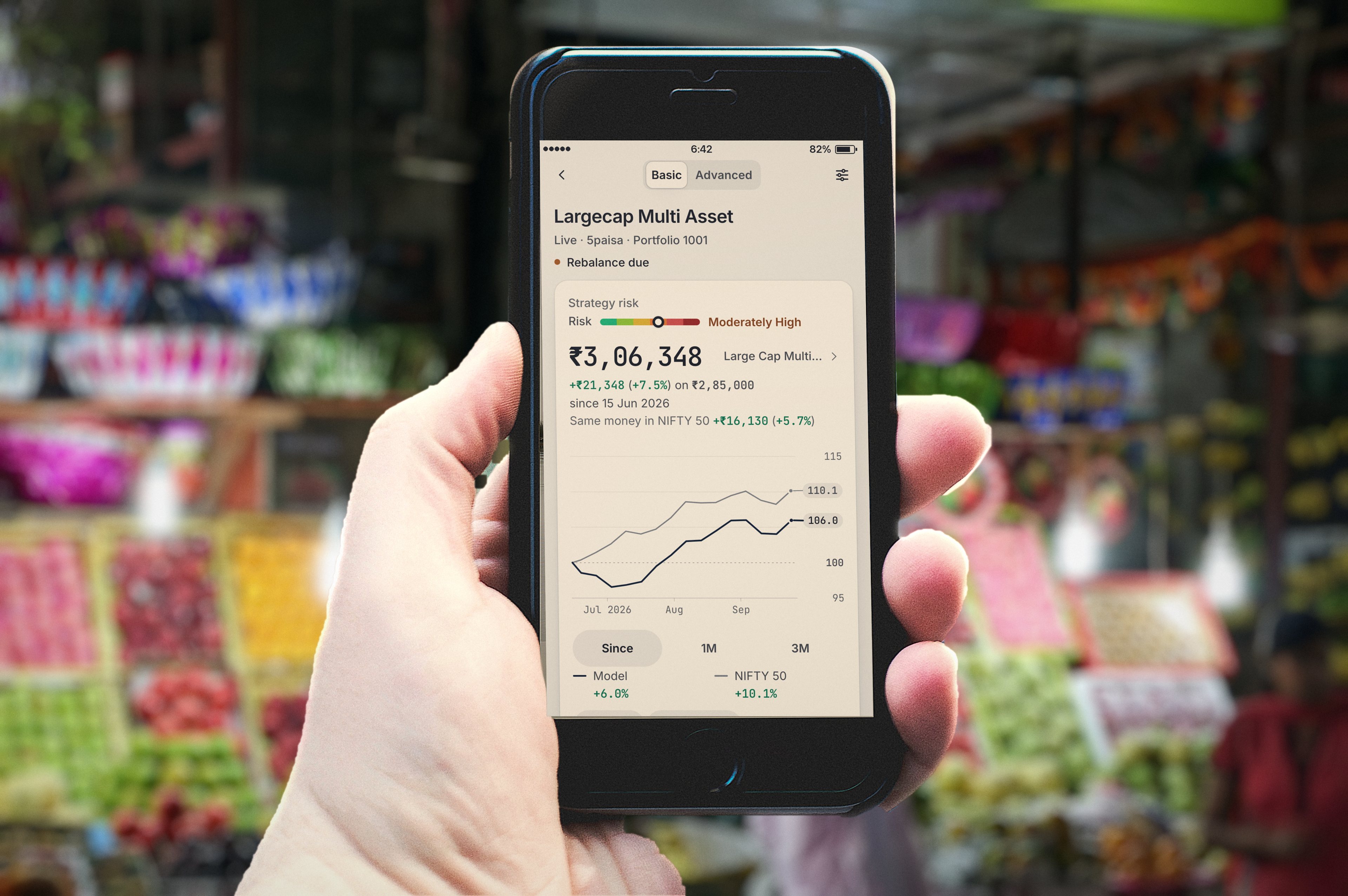
Research, invest, rebalance and track from one desk. The screens here are the product, on sample data.

A hand holds a phone showing a RupeeCase sample portfolio in front of a fruit stall at Crawford Market, Mumbai

03Your portfolio

Your money,
from day one.

Actual value, profit and every order since the day you invested. Never a back test dressed as your result.

  • Live pricesholdings valued as they trade
  • Money in and outevery rupee, dated
  • Rebalanceson a calendar, one tap
Executes on through SEBI registered brokers Your broker 5paisaLive ZbZebuLive ArArrowLive KtKotak SecuritiesSoon GrowwGrowwSoon A1Angel OneSoon

04Custody

Your money never leaves your broker.

RupeeCase sends the model portfolio as signals. It never holds your money or your shares. You approve, your broker places the orders on NSE and BSE, and the shares settle in your own demat, in your name.

  • Money and shares
  • Orders and fills
  • Signals only

Sign up for RupeeCaseHow it works, step by step

05How it works

Rules in.
Orders out.

  1. 01Rules, not opinionsEvery strategy ranks its universe by fixed rules and holds the top names.
  2. 02Rebalanced on a calendarOn each date, what came in, what went out and what stayed is published.
  3. 03One fee, when it trades0.2% of traded value, per rebalance. No subscription, no AUM fee.
  4. 04You approve, your broker executesThe real rebalance screen, on sample data.
MethodAllcap, as an example

Rules rank the universe. The top names make the portfolio.

UniverseNIFTY TOTAL MARKET Ranked by rulesSAME RULES, EVERY TIME 50STOCKS HELD
  1. 01UniverseNifty Total Market
  2. 02Ranked by rulesSame rules, every time
  3. 0350Stocks held
MomentumMulti assetFactorResearch Lab

Momentum, factor and multi asset rules across largecap, midcap, smallcap, microcap and thematic baskets, run the same way every time. Every holding, every rebalance and every rule is published.

RebalanceModel record

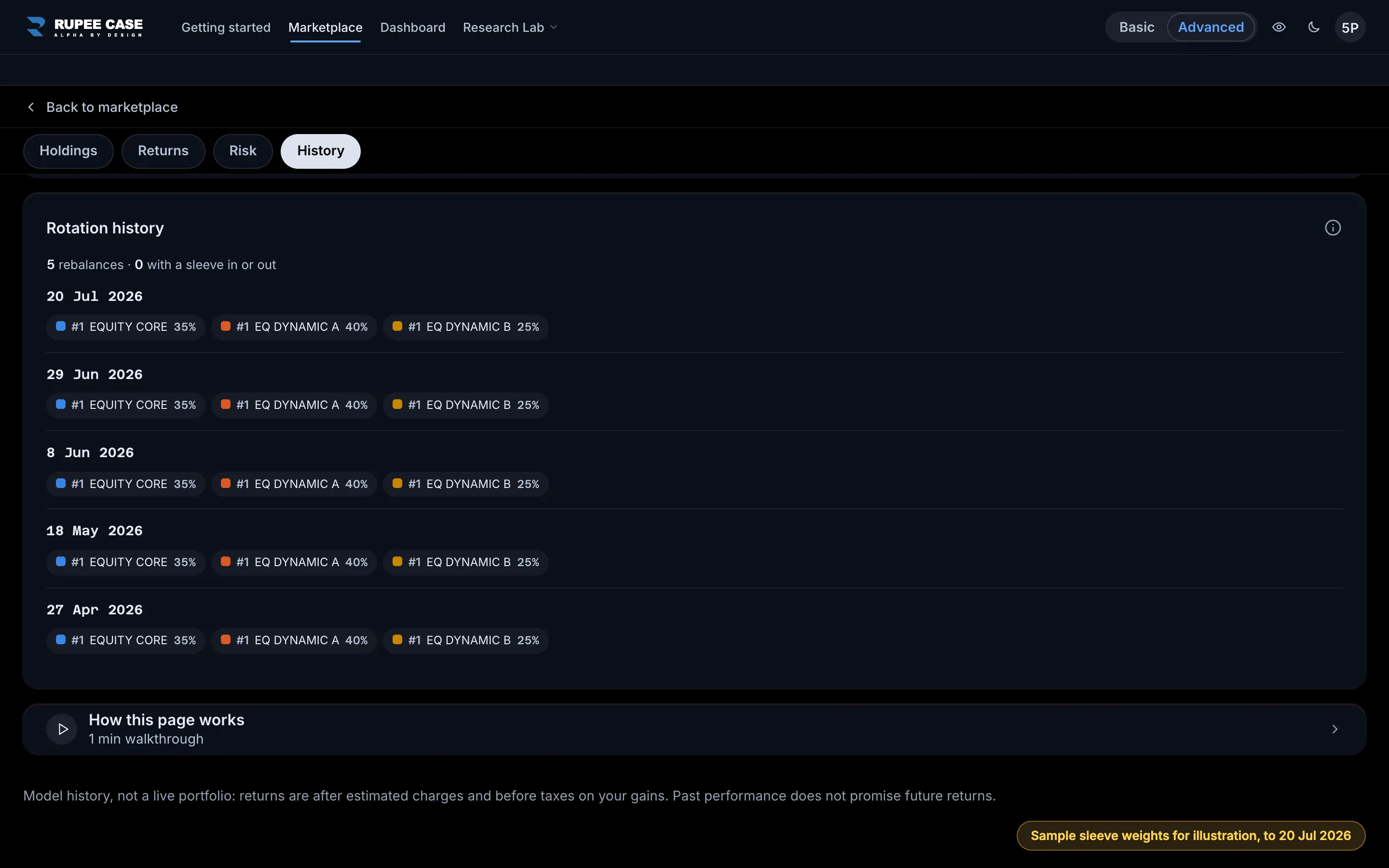
On every date: in, out and held.

What came in, what went out and what stayed, on the date it happened. Replayed here from the published record.

PricingAnnual cost, a year

0.2% of traded value. Only when a strategy trades.

RupeeCase1.2 to 3.3%
Mutual fund0.3 to 2.5%
PMS2% + 20%
AIF~2% + 20%

RupeeCase: 0.2% of traded value, worked out from each strategy’s published rebalance record for the latest year: about 1.2% to 3.3% of capital, Allcap about 2.2%, Nifty 50 Equal Weight under 0.1%. Turnover varies year to year. Others: typical ranges per year; PMS and AIF (Category III) add about a 20% profit share, with minimums of ₹50 lakh and ₹1 crore. Brokerage and taxes are separate, via your broker.

The productSample data

You approve. Your broker places the orders.

06The record

Every line,
drawn from the record.

Monthly model values for all 18 strategies since 2021, from the same files the strategy pages publish. Hover any month.

Indices live 18 Every one with its rule, record and rebalance dates
Lowest entry ₹22,000 5Paisa Focused Alpha 5. Highest: ₹4,75,912, 8 Aug 2026
Highest back test CAGR 54.1% Model, back tested
Per trade 0.2% Of traded value. Only fee. Only when it trades

Every rebalance, in the open.

See the 18 strategiesCompare them side by side

07Who it is for

One engine.
Every kind of wealth.

The same index algos and the same single fee, from a first portfolio to a family office.

08Why systematic

The data
speaks.

  1. 01Most active funds trail the indexSPIVA India 2024, large cap funds against their benchmark.
  2. 02Only 10 of 50 survivedThe Nifty 50 of 1996, still in the index today.
  3. 03Human or systemGuesswork and fees, or rules defined upfront.
  4. 04A plain index, or a better ruleChosen by size, or by a published rule.
  5. 05Try it: the momentum raceRank by recent strength, hold the top ten, swap the laggards.
The dataSPIVA India 2024, SEBI

Most active large cap funds failed to beat their index.

60%
failed in 1 year
75%
failed over 3 years
93%
failed over 5 years
87.7%
of individual F&O traders lost money in FY26

Sources: S&P Global SPIVA India Scorecard 2024 (active large cap funds); SEBI study of August 2026 (F&O, FY26).

Nifty survivorsNifty 50, since 1996

50 companies started. Only 10 survived.

Still in the Nifty

HDFC BankRelianceL&TTata MotorsSBIITCTata SteelHULDr. Reddy'sGrasim

Replaced, among 40

Yes BankSuzlonJP Assoc.UnitechIFCIMTNLSatyam

Size alone is not a rule. 40 of India's largest were quietly replaced.

Human vs systemSPIVA India 2024

Rules defined upfront. Zero emotion.

Human fund manager

Guesses which stocks to buy

Panics in downturns

Charges 1 to 2% every year

A black box

Systematic index

Rules defined upfront, never change

Zero emotion, zero panic

0.2% of traded value, per rebalance

Fully transparent

SPIVA India 2024: 85%+ of large cap funds trailed the index over 10 years.

The differenceWhat makes an index superior

Change the rule, change the result.

A plain indexA RupeeCase index
Chosen byCompany sizeA published quantitative rule
ChangesTwice a yearA fixed short cycle, every rebalance logged
Who holds itA fund, you hold unitsYou, in your own demat
CostsA yearly fee on the whole amount0.2% of traded value, only when it trades

Superior means the rule beat the plain index over its published back test window, with brokerage, STT, exchange charges and GST deducted.

Interactive demoThe horse race

Rank by momentum. Hold the top ten. Swap the laggards.

Lap 1An illustration of the idea, with made up scores. Not a strategy or a recommendation.

09The wealth creation engine

Invest, pledge, track, analyse. One terminal.

Recorded from the RupeeCase terminal on sample data. Not a render, not a mock up. Pick a screen; tap any still below to open it large.

Smart ledger
  • Pledge for marginYour index holdings stay invested in your demat and, pledged via your broker, back the margin you trade with on your own.
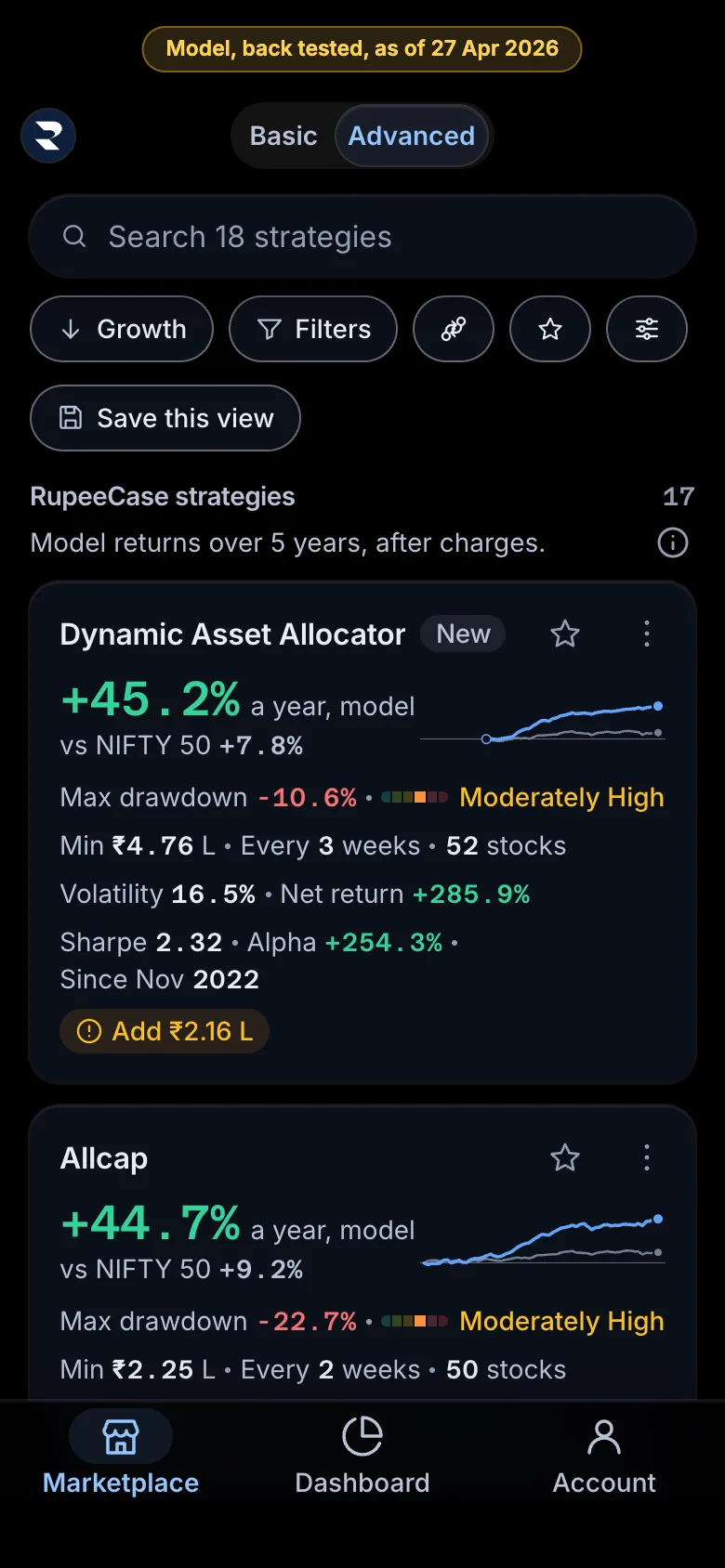
RupeeCase terminal: The lineup. Filter by tier, cap, theme, risk, holdings, minimum or rebalance.
01The lineup
RupeeCase terminal: Table view. Every strategy on one row when you want to scan, not browse.
02Table view
RupeeCase terminal: Compare. Add up to ten indices, funds or strategies to a strategy's chart before you commit.
03Compare
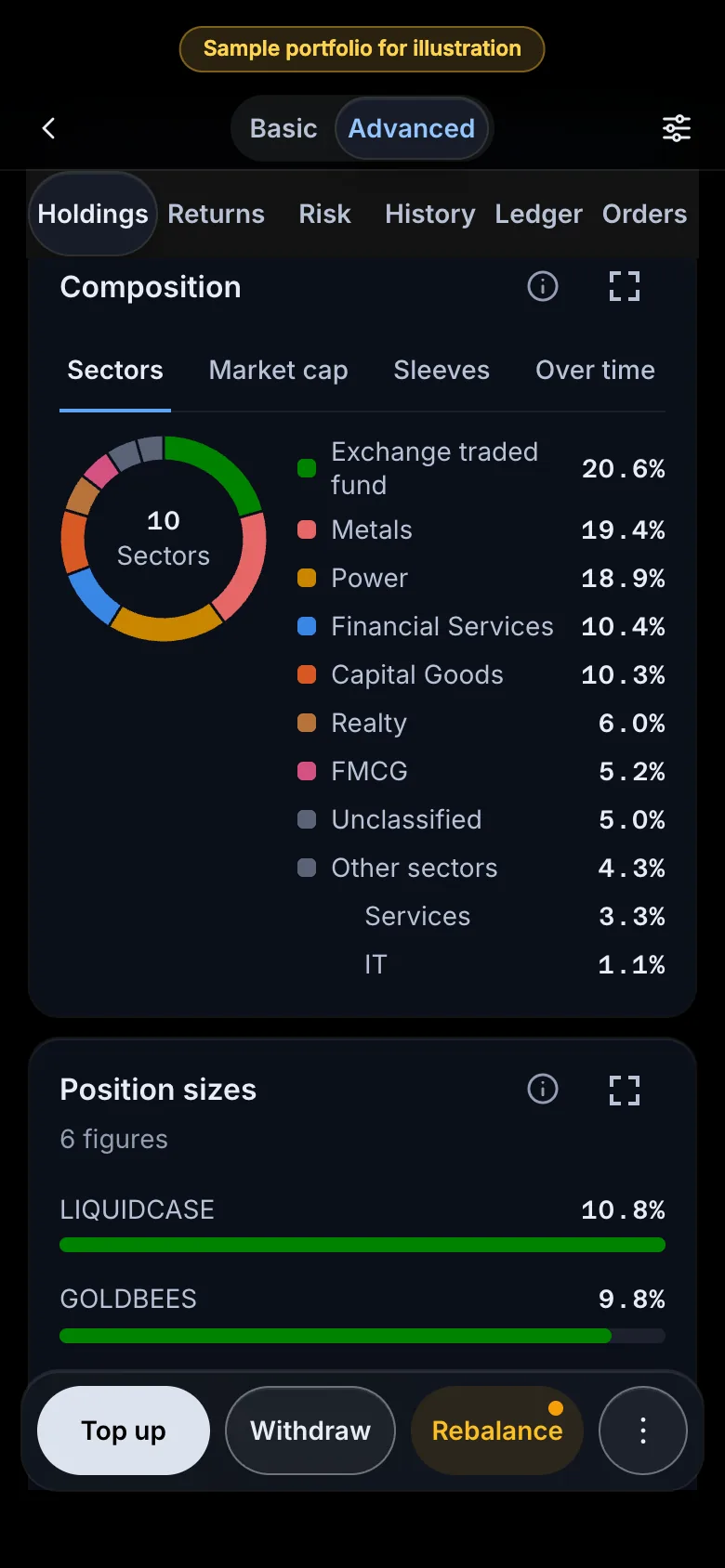
RupeeCase terminal: Your holdings. Every share, weight and profit, sitting in your own demat.
04Holdings
RupeeCase terminal: Confirm rebalance. Nothing goes to your broker until you tick I accept and confirm.
05Rebalance
RupeeCase terminal: The Ledger. Every money in and out and every rebalance, with its orders at your broker.
06Ledger
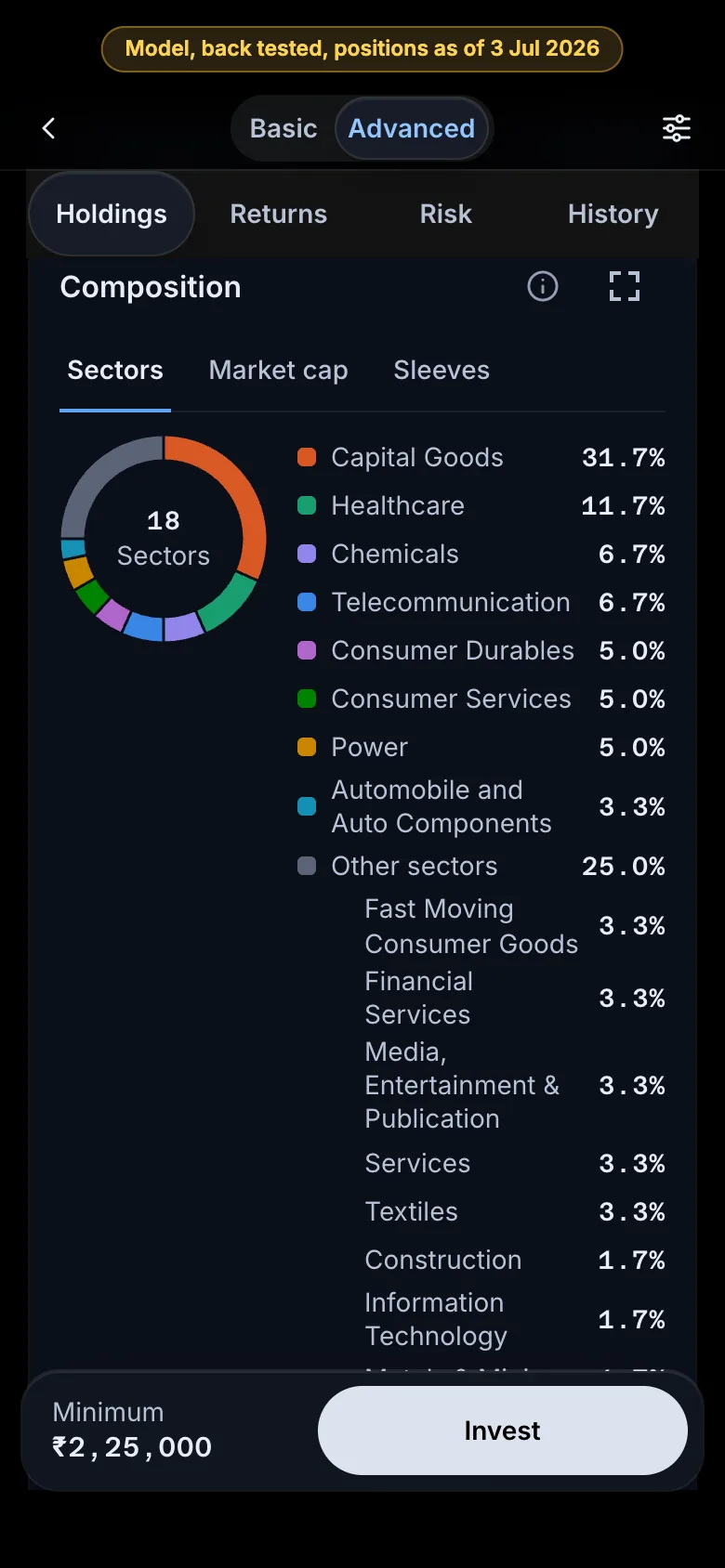
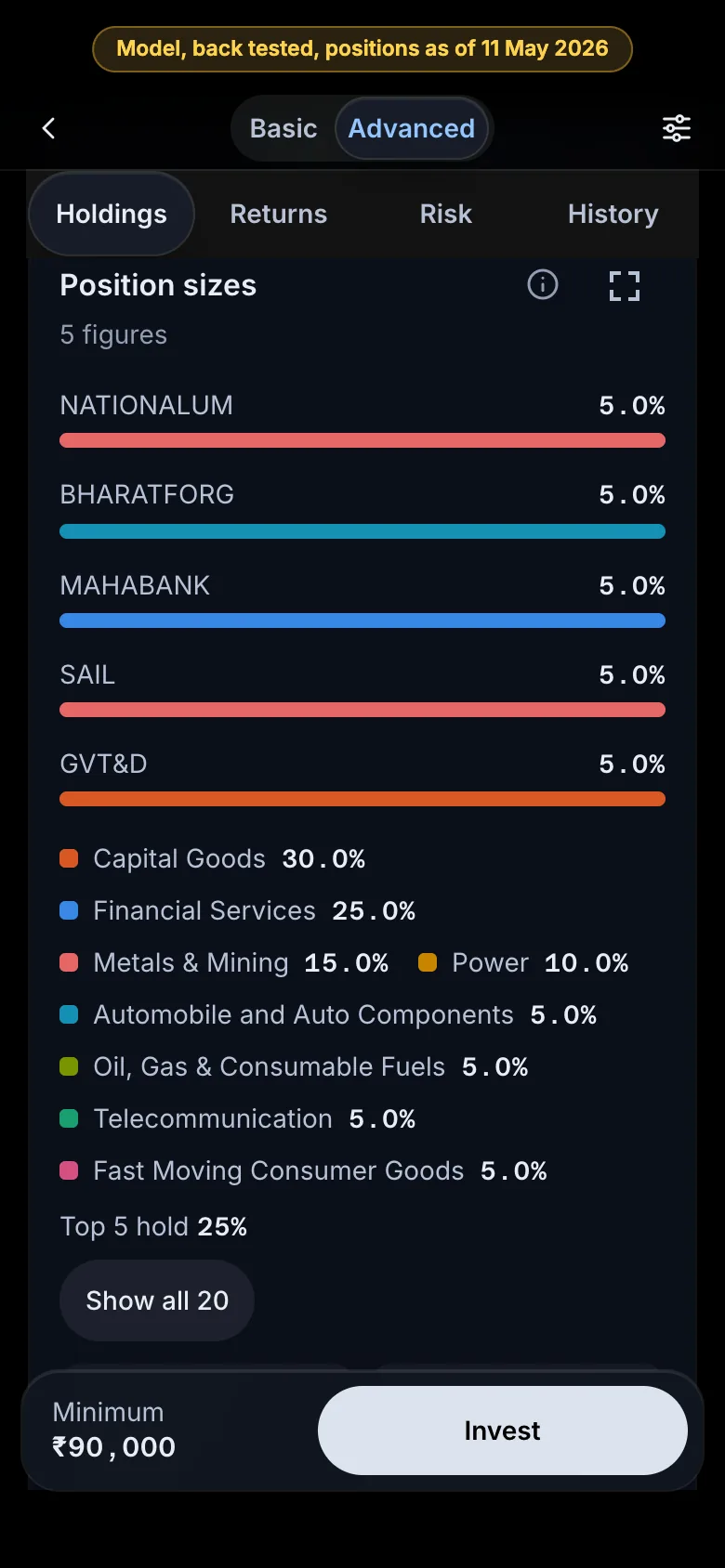
RupeeCase terminal: The model holdings. The stocks the ranking picked at the last rebalance, with their weights.
07Model holdings
RupeeCase terminal: Research lab. Build an index from a universe and read its history.
08Research lab
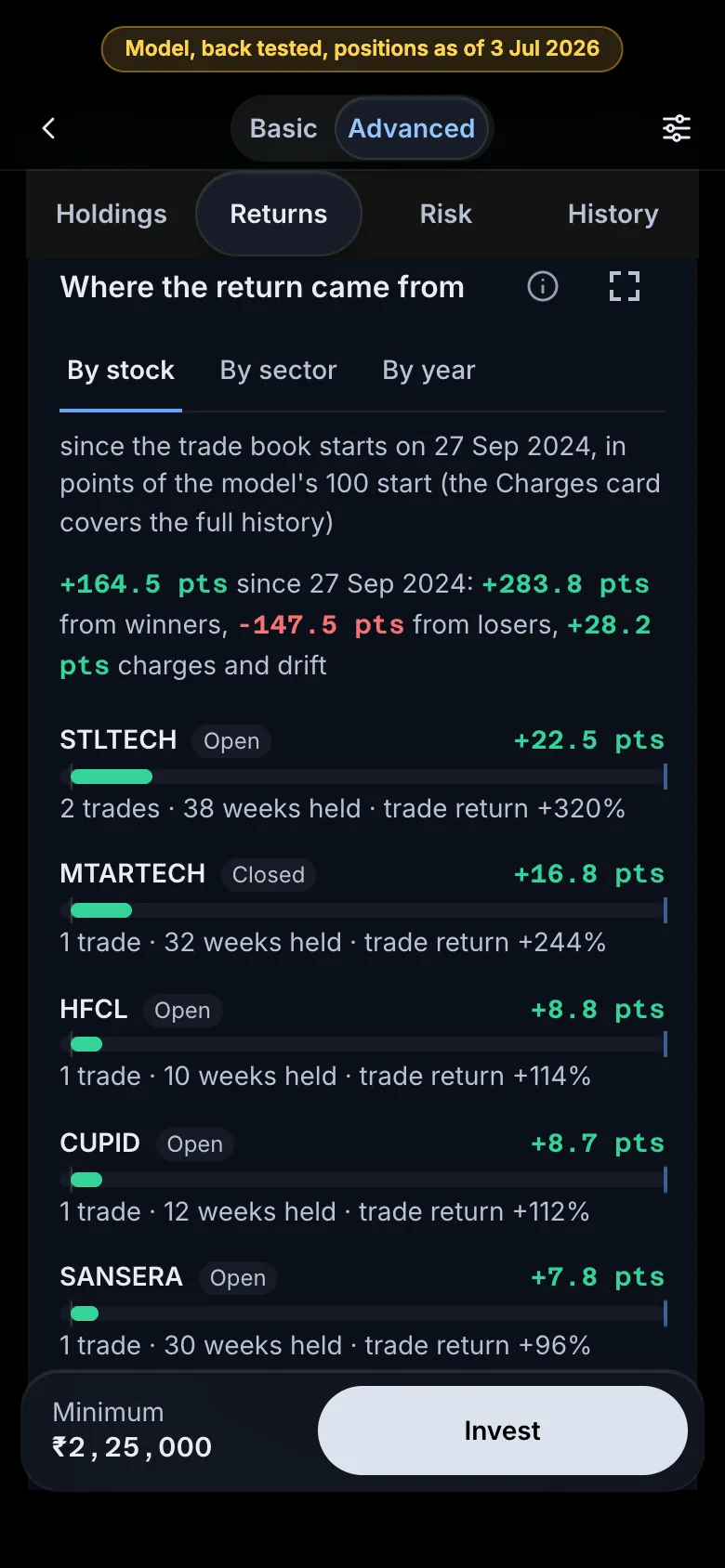
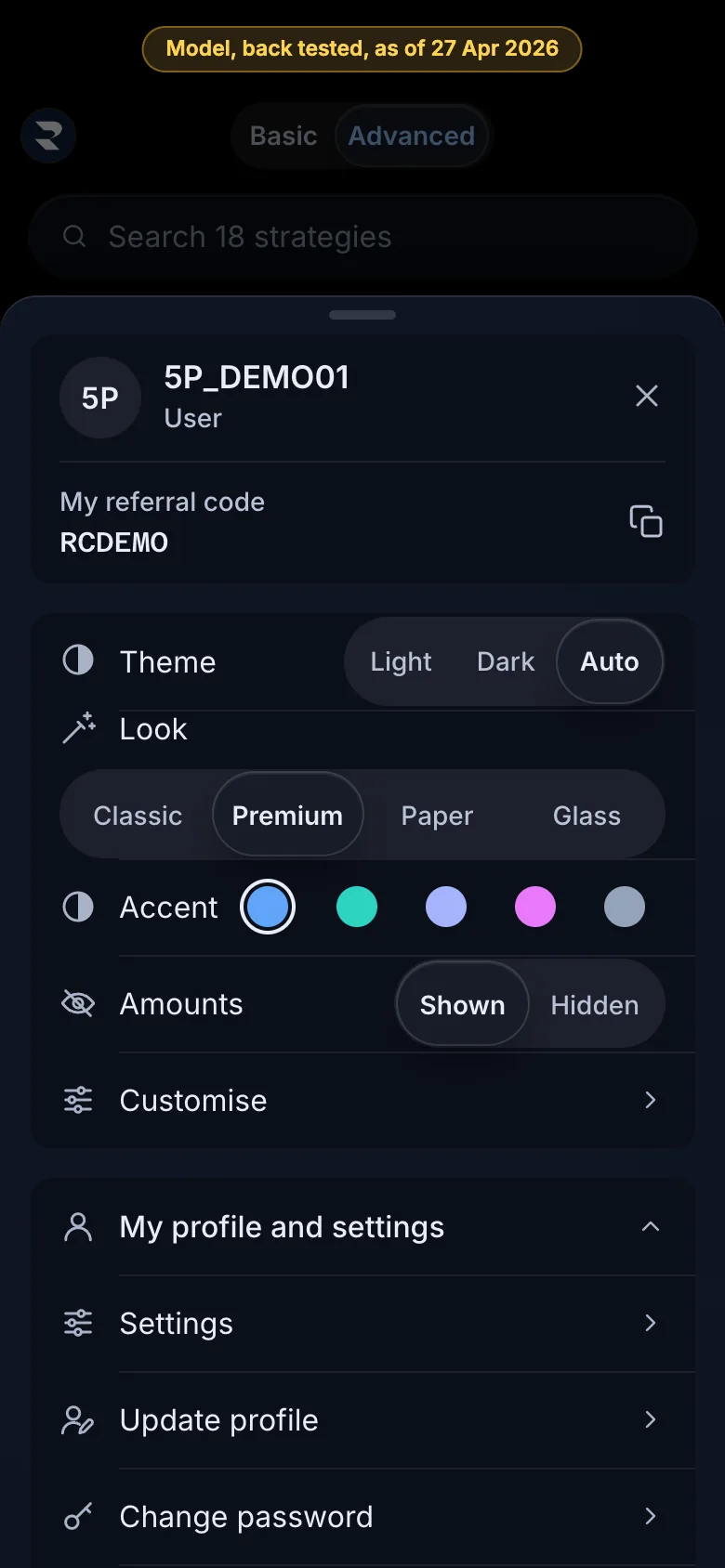
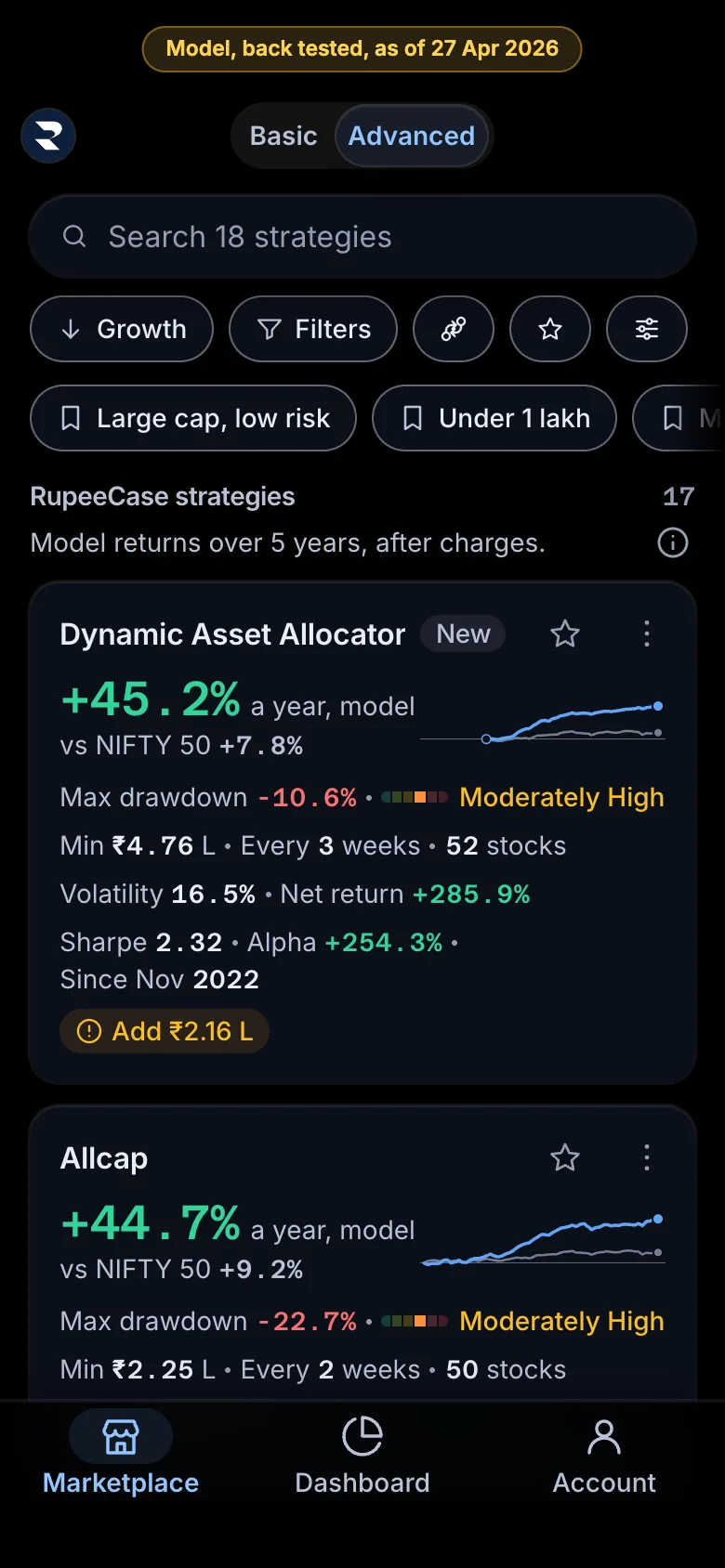
RupeeCase terminal: On a phone. The same terminal, one column.
09On a phone

Screens are from the live terminal with a demo account. Light and dark follow your theme. Figures shown come from the same data as the index pages.

10See it work

Your money stays in your demat. Watch it.

A screen recording of the RupeeCase app, chapter by chapter: you log in with your own broker, RupeeCase reads the cash there, Live orders wait for your consent, and the orders and shares sit at your broker.

Steps in this video
  1. You log in with your broker account, here 5paisa.
  2. Your broker account groups its portfolios on the Dashboard.
  3. Fetch reads the cash available at your broker.
  4. Invest opens the sheet with the minimum as the amount.
  5. Live places real orders in your own broker account.
  6. No order goes out until you accept the consent text.
  7. Orders lists what is open at your broker.
  8. Holdings lists the shares this portfolio holds in your account.
  9. The guide answers the question in plain words.
  10. RupeeCase never holds your money. Cash and shares stay with your broker.

Recorded from the RupeeCase app with a sample investor. Strategy figures are the published model figures, back tested; cash and portfolio figures are a sample for illustration.

11The journey

Compare. Validate. Invest.

Every index side by side with a mutual fund, a PMS or an AIF; every month of the model read before you put in a rupee; then the index, in your own demat.

01 CompareWealth creation, side by side

An index, a mutual fund, a PMS or an AIF.

RupeeCase indexMutual fundPMSAIF
Minimumfrom ₹22,000low₹50 lakh₹1 crore
Cost0.2% of traded value0.3 to 2.5% a year2% + 20%~2% + 20%
Who holds itYou, your dematThe fundYour demat, managedThe fund
RulesPublishedManager's callManager's callManager's call
Lock inNoneVariesVariesOften years

Typical figures for each category. Minimums for PMS and AIF as set by SEBI.

02 ValidateModel, back tested

Read every month before you put in a rupee.

03 InvestSample data

Then invest in the index, from your own broker.

An algo, packaged like an index, in your own demat.

The modelsAI and machine learning

Optimised by machines. Run as fixed rules.

Market dataNSE, BSE Published ruleRUNS THE INDEX
  1. 01Market dataNSE, BSE
  2. AI and machine learning
  3. 02Published ruleRuns the index

Models tuned and tested on NSE and BSE data, then frozen into published rules. The optimisation happens before launch. What runs is a fixed, published rule: the same every time.

ExecutionTick by tick

Every order. Every fill. Every tick.

Orders and fills published tick by tick. Nothing hidden. A replay of a published rebalance record; prices and quantities are illustrative.

13Reviews

4,752 and growing.
59 reviews. 51 five star.

In their own words, from the community. Avatars show initials; names are as given by the reviewers.

  • 4,750+community members
  • 15K+followers on X
Tanmay Kurtkoti at his desk
Tanmay KurtkotiFounder and CEO, QC Alpha

14Who built it

Built by Tanmay Kurtkoti and QC Alpha.

“Institutional grade systematic investing, for anyone with a broker account.”

17 years in quantitative trading, HFT and fund management. The same rules based frameworks institutional desks have run for two decades, without the lock in or the lock out.

  • 17years
  • $75M+managed
  • 5K+mentored
  • MoneycontrolFeatured interview
  • AlphaTrade 2025, BSE MumbaiCo-founded. Sold out. Kotak, 5paisa, Moneycontrol
  • The Tanmay EdgePodcast archive, 124 episodes
  • QC Alpha ResearchMomentum, ETF rotation, low vol, multi factor

Research powered by QC Alpha Research (SEBI Research Analyst registration pending). A technology platform, not a fund, PMS or investment adviser. All trades execute through your own broker via official APIs.

15The curriculum

11 paths. 70 modules.
Free.

1Foundations2Systematic3Factors4Portfolio5Quant6Products7Macro8Behaviour9Business10Execution11Tax12Soon13Soon

16The Tanmay Edge archive

Last 5 episodes,
graded.

124episodes, 16 Mar to 16 Sep 2026
70%hit rate, graded at NSE settlement

Season 2 made specific, checkable predictions read from the F&O participant data, graded against NSE settlement data with no edits and no cherry picking. The archive now lives in Learn.

Open the podcast archive

Loading the graded episodes.

Hit: green at 60% or more, amber at 40% or more, rose below. Half points count, so 4.5/5 is 90%. Range, VIX, pin level, ceiling and gate state, graded against NSE settlement.

17Questions

Things investors actually ask.

Straight answers to the eleven we hear most.

About RupeeCase

What is RupeeCase?

RupeeCase is a systematic investing terminal built by QC Alpha Technologies Pvt Ltd. It runs 18 rules based indices on NSE and BSE: you pick an index, link your own broker, and the platform sends the orders each rebalance generates. It is a technology platform, not a fund or a PMS.

Is RupeeCase SEBI registered?

RupeeCase is a technology platform operated by QC Alpha Technologies. It is not a fund, a PMS or a SEBI registered investment adviser. A SEBI Research Analyst registration has been applied for via QC Alpha Research Pvt Ltd and is pending. Read the disclaimers and the grievance process.

How does rebalancing work?

Each index re runs its rule on a fixed calendar, from every week to every 4 weeks. The platform shows the names going in and out, you approve the rebalance, and your broker places the orders. Every rebalance is published on its date in the rebalance record. More answers in the RupeeCase FAQ.

Getting started and safety

How do I get started with RupeeCase?

Create a free account at invest.rupeecase.com, take the risk profile, pick an index that fits your goal, and connect your broker. You can paper trade first and deploy real capital when ready. No subscription and no lock-in.

Is my money safe with RupeeCase?

RupeeCase never holds your money. It is a technology platform, not a fund or PMS. All trades execute through your own broker account via their official API. Your money stays in your brokerage account at all times. Markets still carry risk, so the value of your holdings can fall. Read more about investor protection at SEBI.gov.in.

Can I lose money on RupeeCase?

Yes. All investments carry risk. RupeeCase indices invest in equities which can lose value in downturns. Diversification and a fixed rebalancing schedule reduce single stock risk but do not remove market risk. Always invest only what you can afford to hold through market cycles.

Can I withdraw anytime?

Yes. No lock-in. Your capital is in your broker account. Add or withdraw with normal brokerage settlement.

Pricing and platform

What are the platform fees?

0.2% on traded value, only when trades execute. No subscription, no AUM fee, no performance fee.

What is the minimum investment?

Minimums range from ₹22,000 (5Paisa Focused Alpha 5) to ₹4,75,912 (Dynamic Asset Allocator) depending on the index, published minimums as of 8 Aug 2026. Each index holds whole shares, so the figure moves with prices; the exact minimum is on each index card.

What brokers are supported?

5paisa, Zebu and Arrow are live today. Kotak Securities, Groww and Angel One are in integration. You keep your existing account; RupeeCase only sends the orders the rule generates.

How do the backtests work?

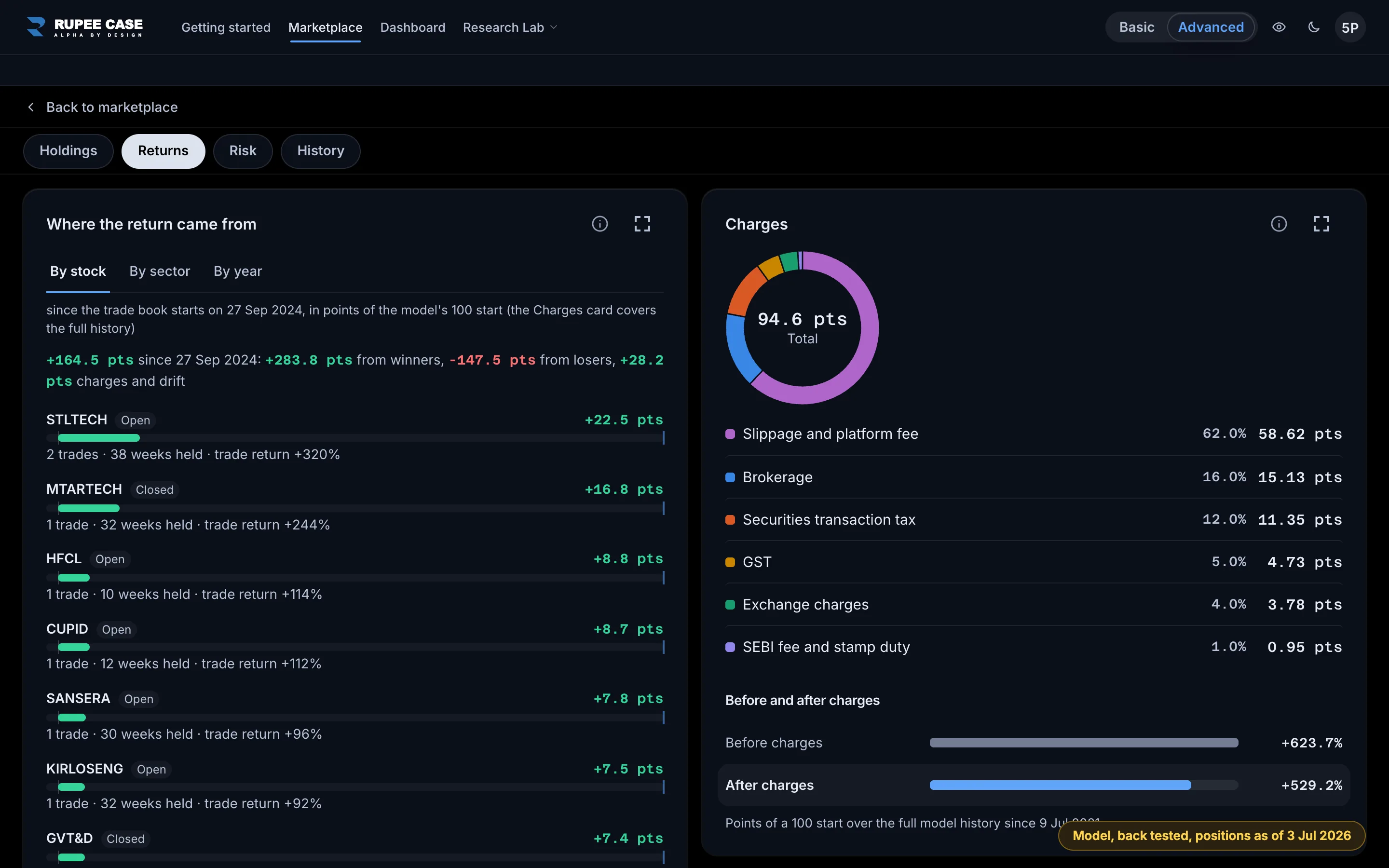
Each index rule is run on NSE BhavCopy prices from its back test start, with brokerage, STT, exchange charges and GST deducted. Figures are model, back tested, as of 27 Apr 2026; they are not actual client returns, and past performance does not guarantee future returns.

QC Alpha · RupeeCase

Own the index.
Keep your broker.

Free to start. 0.2% of traded value per rebalance, only when trades execute. Your capital stays in your own broker account.

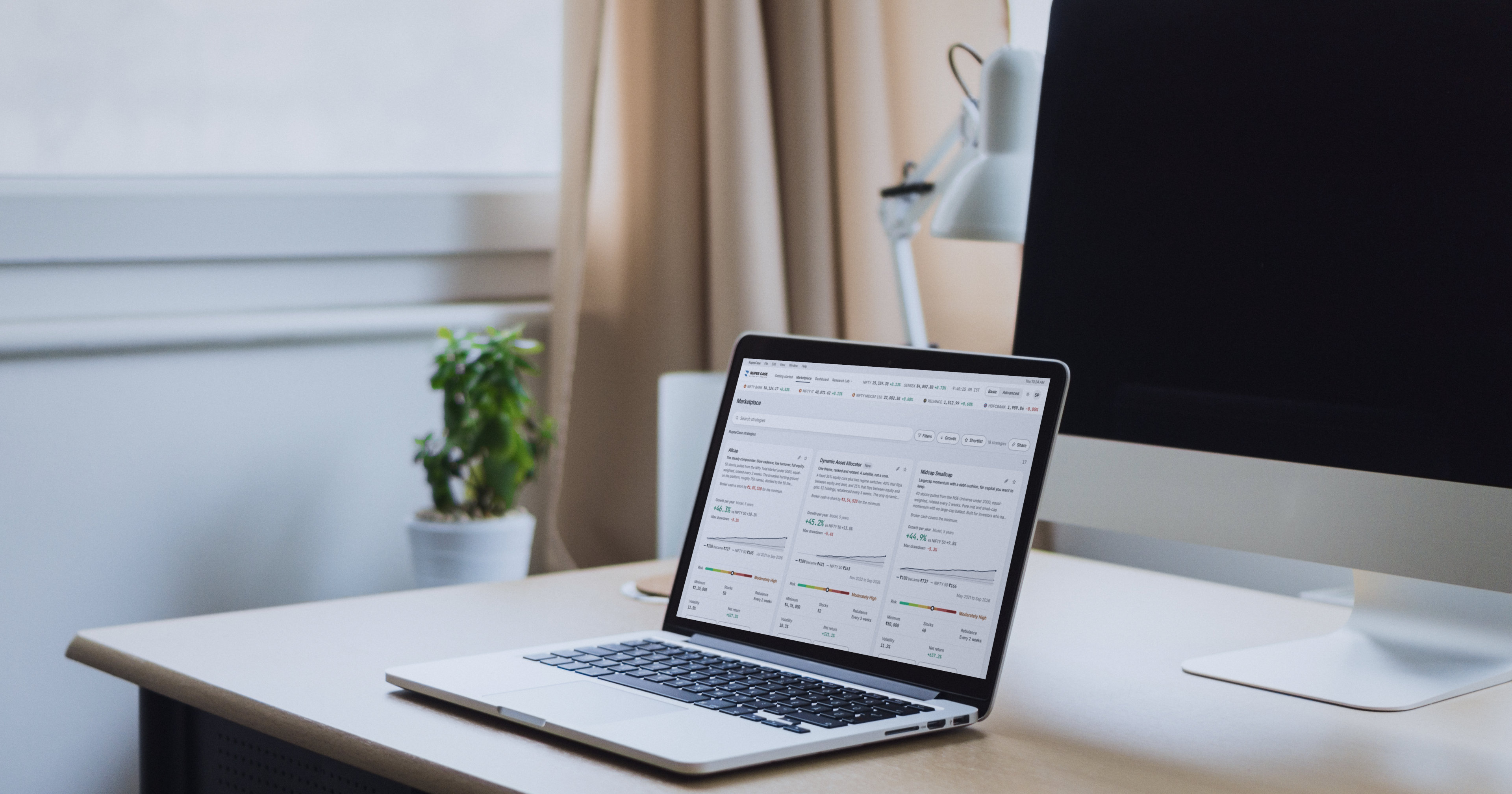
A laptop on a bright desk by a window showing the RupeeCase marketplace in light theme
Light theme, at the desk.
A tablet and a phone in daylight showing the RupeeCase marketplace and a strategy, light theme
Tablet and phone, the same account.